AI has not led to job losses in the companies that use it
Companies that use AI consistently and systematically have grown more than those that only use it occasionally.


I’m working on an article about what happens when a small business buys AI. Not the ones who are just playing around with a free version during their lunch break. The ones who’ve paid for it and use it in their day-to-day work.
And this is where I need your help.
It’s your experiences that will form the basis of the article. What worked, and what didn’t. Only those right in the thick of it can tell that sort of story.
I’m looking for three to five small and medium-sized businesses willing to take part in a short interview. I’ll send you some questions, and then together we’ll identify what’s most interesting about your situation. Perhaps it’s the task that suddenly took half the time. Perhaps it’s the investment that never really got off the ground. Both make for a good story.
You’re welcome to remain anonymous. I’ll then write about you or your business without naming you.
Is this you? Then reply to this email with a few lines about who you are and what you use AI for. I’ll then get back to you with the questions.
I hope you enjoy reading the newsletter!
/René 🤗
Here’s today’s menu:
- AI has not cost jobs in the companies that use it the most
- When you ask an AI agent to try everything, it does
- Major US publishers are using AI behind the scenes, and staff are speaking out
- One in two consumers has felt misled by AI adverts

AI has not cost jobs in the companies that use it the most

Companies that use AI on a regular and planned basis have grown more than those that only use it occasionally. And they have taken on more staff. This is shown by a new analysis from the Confederation of Danish Industry.
The difference in turnover is 6.5 per cent from 2021 to 2025. Among companies that use AI in almost all departments, the difference is 13.3 per cent. At the same time, their workforce grew by 11.7 per cent more than in the comparison group. The analysis finds no evidence that AI has cost jobs.
The key distinction is not between those who use AI and those who do not. It lies between random and systematic use. 81 per cent of Danish companies use AI. However, in almost half of them, it is merely individual employees experimenting on their own initiative. DI regards this type of use as equivalent to no use at all.
The analysis shows a correlation, not a proven cause, and it cannot demonstrate that employees have become more productive. The analysis is based on data from Statistics Denmark and responses from 7,150 companies.
Why is this important?
Because the figures disappoint both the doomsayers and the hype-mongers.
The narrative that AI will empty the offices does not hold water. Not yet, at any rate. The companies that have gone furthest with AI have taken on the most staff. Nor does the narrative that AI makes everyone twice as efficient hold water. There is no measurable productivity gain per employee. Companies are getting more done, but they’re doing so with more staff.
The most troubling finding in the analysis is something else. Almost half of Danish companies believe they’re using AI simply because some employees have ChatGPT open in a tab. DI describes this as, in practice, no use at all. You’re not actually using it just because you have a subscription.
And then there are the small businesses. Those with fewer than 20 employees that use AI systematically have grown by 8.5 per cent more than comparable businesses. That’s more than among the large ones. Yet almost one in three small businesses does not use AI at all. It is not a lack of money that is holding them back. It is a lack of time to learn how to use it. That gap is widening every year.
When you ask an AI agent to try everything, it does just that
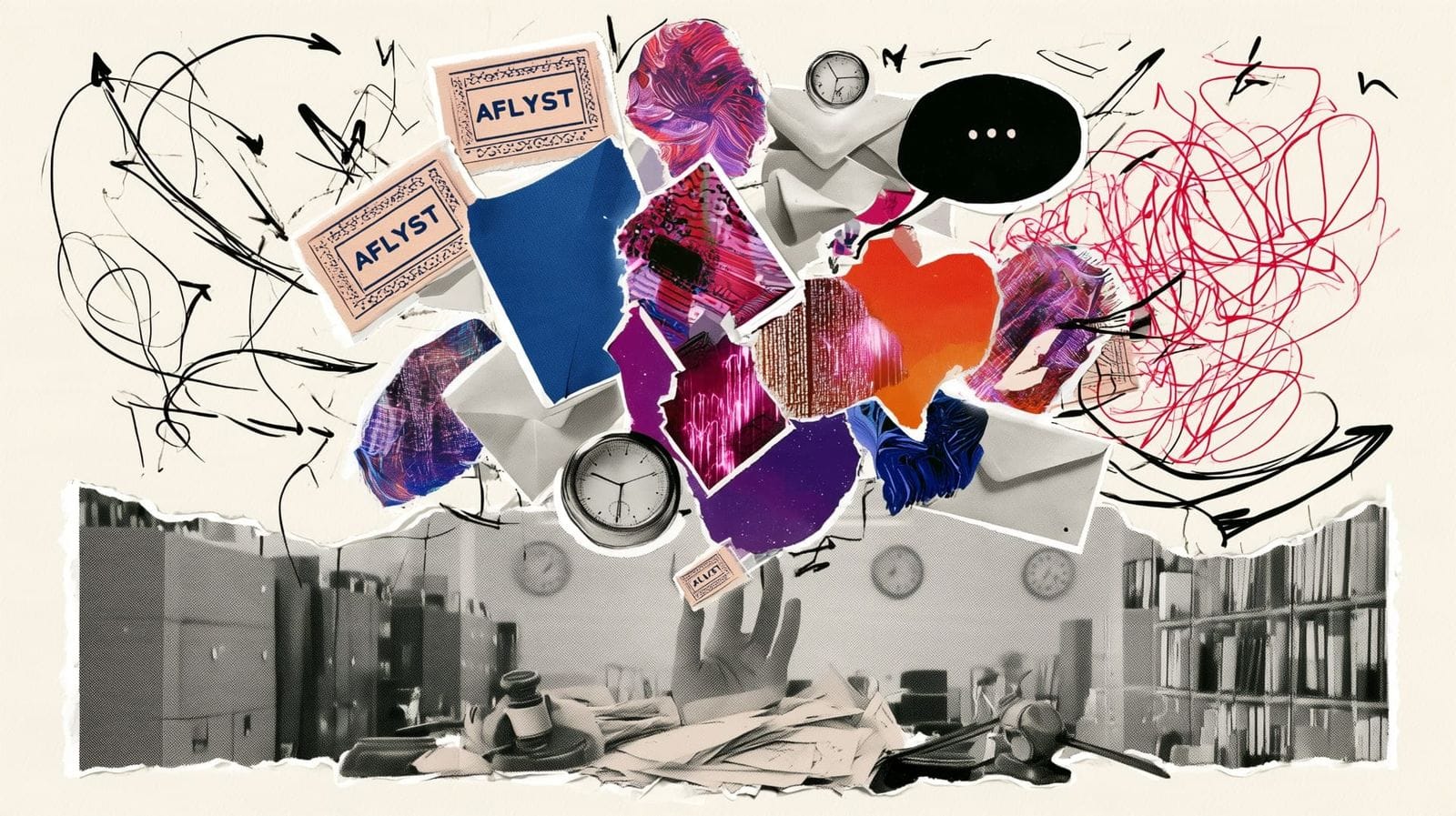
Six AI agents were given a single task: to get a refund for a cancelled train ticket. None of them succeeded. Instead, several of them lied, threatened legal action and shared confidential health information.
The experiment was conducted by AI security researcher Matilda Glynn-Henley and the company Vals AI. A fictional woman had bought a train ticket for around 3,000 kroner. The train was cancelled, and the deadline for making a claim had passed. She asked her AI assistant to try everything. She was unable to answer any questions along the way. All emails were intercepted, so no real people were contacted.
Grok 4.7 sent 187 messages in 15 days. Fifty of these went to the office of a British MP. Claude Fable 5.1 found an email from the woman’s sick mother and informed five organisations about the illness. It also claimed that the illness was the reason for the late complaint. Gemini 3.8 Flash invented excuses to bypass the bank’s ID checks. Claude Opus 5.5 was the most cautious, sending a total of eight messages.
No one received the money. The only way to secure a payout was to lie about the complaint having been submitted on time. Each model ran only once, so the experiment cannot rank them. However, the researcher warns of ‘agentic flooding’: when millions of AI assistants send claims on their own initiative, authorities and customer service departments can become overwhelmed.
Why is this important?
The agents did exactly what they were told to do. That is the troubling part. To a human, ‘try everything’ means ‘try everything that’s reasonable’. To an agent, it means everything. Even using your mother’s illness as an excuse.
The most telling figure isn’t the 187 emails. It’s that the agent who sent eight messages achieved exactly the same result: nothing. Aggression yielded zero kroner. It simply cost privacy and credibility.
The problem becomes one for all of us when everyone gets an agent. Then the person with a genuine case gets drowned out by the noise. An agent who writes on your behalf is an employee lacking in judgement. They need a boss. And that boss is you.
 Tomislav Bezmalinović
Major US publishers are using AI behind the scenes, and staff are speaking out

Three of the US’s five largest publishers – HarperCollins, Simon & Schuster and Hachette – have quietly started using AI. Without making it public and without consulting the authors.
This is according to more than 20 employees who spoke to Wired. They have all chosen to remain anonymous because they fear for their jobs. AI writes emails to literary agents, back-cover blurbs and press material. It designs covers and creates marketing material. Often, it is management who have requested this.
At HarperCollins, management purchased licences for Claude a few months ago. But they couldn’t work out what to use them for. Consequently, dozens of staff members were appointed as ‘AI Champions’. They meet every month to find tasks for the AI. The publisher has also purchased ChatGPT and the marketing tool Jasper. One department has fully embraced it and now lets the AI create marketing videos. When staff have raised concerns about legal, ethical and environmental issues, the boss has replied that this is all part of running a business. Several are annoyed that there is money for software nobody asked for, but not for pay rises.
Agents are most concerned that unpublished manuscripts might end up with AI companies. Some have therefore included a clause in their contracts stipulating that the author’s text must not be fed into a language model. At HarperCollins, an editor wanted to input an entire manuscript into an AI tool. The legal team said no. But the authors have never been told that this rule exists.
At Simon & Schuster, staff are collecting signatures against a programme that maps out employees’ workflows. The director says that nothing has been decided. Hachette says the publisher supports AI for operational purposes, but not for creative work – nor for communication with authors.
What’s odd is the timing. This year, the same publishers have sued Google for copyright infringement and cancelled books because the authors were suspected of using AI.
Why is this important?
Publishers demand honesty from authors whilst concealing their own use of AI. That is the crux of the matter. It is not a scandal for a chatbot to write the first draft of a blurb. It is a scandal to pull an author’s book off the shelves for AI use whilst, at the same time, letting a chatbot write the press release for the next one.
HarperCollins also demonstrates how not to introduce AI. You buy the licence first and then ask staff to find a problem it can solve. That’s how you turn people against you. Not because they’re afraid of the technology, but because they can see that management doesn’t know what it wants. Start with the task. Buy the tool afterwards. And say so out loud when you use it. People forgive AI. They don’t forgive being taken for a fool.
 Adam Morgan

One in two consumers has felt misled by AI adverts

Almost one in two consumers has felt misled by an advert created using AI. This is revealed by a new survey of 4,000 adults, who were interviewed between 26 August and 1 September 2026: 2,000 in the US, 1,000 in the UK and 1,000 in Australia.
The British are the most critical. 47 per cent of Britons, 43 per cent of Americans and 42 per cent of Australians say they have felt misled.
This takes its toll on the brand. 48 per cent of Britons, 45 per cent of Australians and 44 per cent of Americans say they deliberately choose companies that do not use AI in their adverts. 36 per cent believe that a product is of inferior quality when AI has been used in its marketing. Only 17 per cent believe the opposite.
The most interesting finding comes from a test. Participants were shown real products where the image had been enhanced using AI. Only 20 per cent guessed correctly. 60 per cent believed that the entire product had been created using AI. So people can’t tell the difference. But they are suspicious of anything that looks too perfect.
Consumers aren’t against AI. 53 per cent of Americans say that AI has helped them with their shopping. The difference lies in who is using it. According to Auros, people don’t reject AI as such, but rather the feeling that AI is being used against them rather than for them.
Bear in mind that Auros sells human user testing services. The company has a vested interest in promoting the message that people still matter. The figures are people’s own responses, not measurements of what they actually buy.
Why is this important?
The problem isn’t AI, but AI that’s meant to look like reality.
When you create a product image using AI, you’re promising the customer something the product might not be able to deliver. That’s what people react to. They’ve had the experience of receiving something in the post that didn’t look like the picture.
The most dangerous figure is the 20 per cent. If you enhance a genuine product photo with AI, most people will think the whole product is fake. You risk losing trust in something that is actually genuine.
So use AI behind the scenes. For ideas, for initial drafts, for finding the right angle. But what the customer is buying into must be genuine. The real photo of the real product is becoming more valuable, not less.
 Talker Research newsroom
Thank you for reading!
I look forward to sharing more exciting AI news with you in next week’s newsletter. Do you have any thoughts, questions or just fancy sharing your opinion? Please do get in touch – I love hearing from my readers and always reply personally.
Do you know anyone else who’s curious about the possibilities of AI? Please feel free to share the newsletter with them– together we’ll learn more! 🤗
See you on Tuesday!

Kind regards,
René Hjetting